| «‹ September 2026 ›» | | S | M | T | W | T | F | S | | | 1 | 2 | 3 | 4 | 5 | | 6 | 7 | 8 | 9 | 10 | 11 | 12 | | 13 | 14 | 15 | 16 | 17 | 18 | 19 | | 20 | 21 | 22 | 23 | 24 | 25 | 26 | | 27 | 28 | 29 | 30 | |
|
2013 年 9 月 17 日 星期二  |
| Tight Buffer Cable VS Loose Tube Cable |
分類: 未分類 |
You may familiar with bulk fiber optic cables, but how much do you know the differences between tight buffer fiber and loose tube cable?
1. Cable Design
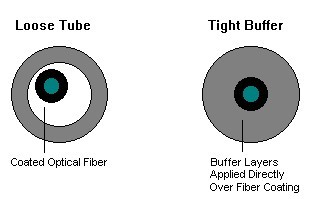
Tight buffer or tight tube cable designs are typically used for ISP applications. Each fiber is coated with a buffer coating, usually with an outside diameter of 900m.
Loose buffer or loose tube cables mean that the fibers are placed loosely within a plastic tube whose inner diameter considerably larger than the fiber itself. Usually 6 to 12 fibers are placed within a single tube. The interior of the plastic tube is usually filled with a gel material that protects the fibers from moisture and physical stresses that may be experienced by the overall cable. Loose buffer designs are used for OSP applications such as underground installations, lashed or self-supporting aerial installations, and other OSP applications.
2. Each Construction Has Inherent Advantages
Each construction has inherent advantages. The loose buffer tube offers lower cable attenuation from microbending in any given fiber, plus a high level of isolation from external forces. Under continuous mechanical stress, the loose tube permits more stable transmission characteristics. The tight buffer construction permits smaller, lighter weight designs for similar fiber configuration, and generally yields a more flexible, crush resistant cable.
The other fiber protection technique, tight buffer, uses a direct extrusion of plastic over the basic fiber coating. Tight buffer constructions are able to withstand much greater crush and impact forces without fiber breakage.
The tight buffer design, however, results in lower isolation for the fiber from the stresses of temperature variation. While relatively more flexible than loose buffer, if the tight buffer is deployed with sharp bends or twists, optical losses are likely to exceed nominal specifications due to microbending.
3. Tensile Loading
Cable tensile load ratings, also called cable pulling tensions or pulling forces, are specified under short-term and long-term conditions. The short-term condition represents a cable during installation and it is not recommended that this tension be exceeded. The long-term condition represents an installed cable subjected to a permanent load for the life of the cable. Typical loose-tube cable designs have a short-term (during installation) tensile rating of 600 pounds (2700 N) and a long-term (post installation) tensile rating of 200 pounds (890 N).
Nowadays there are many big brands fiber optic cable manufacturers available, for example, Corning, who specializes in cables for many years. The corning fiber optic cable is of many types and with high quality. Another famous manufacturer--FiberStore, also offers a wide range of bulk fiber optic cables, including cables from corning and cables for different applications, bulk fiber optic cable can be made in a variety of lengths and configurations to meet your needs.
|
| 2013 年 9 月 13 日 星期五 |
| The Selling Price Of Fiber Optic Cable |
分類: 未分類 |
In general, fiber optics cost from 1 to 5 percent more than standard copper wire and multimode fiber sells at a higher price than single-mode fiber.
Although single-mode fiber is by far the predominant fiber for telecommunications, multimode is used in short-reach applications, including for data centers and some other local area networking deployments, as well as for numerous specialized applications not for telecom, such as medical uses, imaging and some illumination.
Multimode is not cheaper than single-mode fiber. However, the inexpensive LEDs or vertical-cavity surface-emitting lasers (VCSELs) and detectors used to power it are generally less expensive than its single-mode fiber counterparts. The real growth potential is in data centers using VCSELs with multimode fiber. Optical component vendors that can use VCSELs to carry signals in duplex or multistrand multimode fibers may find a market in local area networks or the growing number of data centers throughout the world. Short-range links would appear to be perfect for multimode fibers.
Although konw multimode fiber is more expensive than single mode fiber, what are the other factors deciding the fiber optic cable price?
Fiber optic cable prices are different based on the different cable types, even for the same structure fiber optic cables, the prices may be different because of the different fiber counts, jackettypes, lengths, etc.
The cable design influences the cost of a fiber optic cable. A simple duct cable will be less priced than a direct buried cable, which needs extra protection to meet additional mechanical and environmental safety when the cable is used for direct buried application. A self-supporting type aerial cable may be more expensive than a duct and direct buried type cables. The number of sheaths affects the cost. The more the number of sheathing layers, the higher the cost of cable will be. Process cost and material cost increases drastically proportional to the number of sheathing layers.
It is not always the construction of a cable that decides the cost of a fiber optic cable. The quantity required and delivery also plays major role in the costing of a fiber optic cable. A more quantity, cable manufacturers will offer a cheaper price. When buying a fiber optic cable from fiber optic cable manufacturer, most probably if we approach a cable manufacturer with a requirement of fiber optic cable, they will ask the quantity and delivery time at first apart from the construction requirements.
Fiber optic cable prices from different fiber optic cable manufacturers are also not same, sometimes they may be quite different, even you are asking about the same structure cable, this may be because of the quality, but brand names may also affect the fiber cable prices.
As you know, Corning developed the first commercial optical fiber in 1970. Corning and OFS remain the No. 1 and No. 2 fiber optic cable makers in the world currently. Corning and OFS almost control every aspect of the optical fiber-making process, including extruding the glass from draw towers, doping it, cooling it, stringing it, testing it, marking it, and then either cabling it or shipping it to other cablers.
Another hidden factor influences fiber optic cable price is the market. If the demand is more and competitors are less, the price will be naturally higher. |
| 2013 年 9 月 12 日 星期四 |
| Fiber Optic Cable Basics |
分類: 未分類 |
You hear about fiber optic cables whenever people talk about telephone system, cable TV system or the Internet. They are also used in medical imaging and mechanical engineering inspection nowadays. How much do you know the basic information of cables? For example, what a 9/125/250µm cable mean. In this article, we will show you some cable basics.
Cable Size
The size of the optical fiber is commonly referred to by the outer diameter of its core, cladding and coating. Example: 50/125/250µm indicates a fiber with a core of 50 microns, cladding of 125 microns, and a coating of 250 microns. The coating is always removed when joining or connecting fibers. A micron (µm) is equal to one-millionth of a meter. 25 microns are equal to 0.0025 cm. (A sheet of paper is approximately 25 microns thick).
Cable Types
Cables can be identified by the type of paths that the light rays, or modes, travel within the fiber core. Also according used in different environments, there are outdoor cable, waterproof cables, lszh cable, submarine optical cable, etc.
Distribution Cables
These cables are small in size, and used for short, dry conduit runs, riser and plenum applications. The fibers are double buffered and can be directly terminated, but because their fibers are not individually reinforced, these cables need to be broken out with a "breakout box" or terminated inside a patch panel or junction box.
Breakout Cables
They are suitable for conduit runs, riser and plenum applications. Because each fiber is individually reinforced, this design allows for quick termination to connectors and does not require patch panels or boxes. Breakout cable can be more economical where fiber count isn't too large and distances too long, because is requires so much less labor to terminate.
Loose Tube Cables
These cables are composed of several fibers together inside a small plastic tube, which are in turn wound around a central strength member and jacketed, providing a small, high fiber count cable. This type of cable is ideal for outside temperatures and high moisture conditions(waterproof cables also do good jod in moisture conditions), as it made with the loose tubes filled with gel or water absorbent powder to prevent harm to the fibers from water. It can be used in conduits, strung overhead or buried directly into the ground.
Ribbon Cable
This cable offers the highest packing density, since all the fibers are laid out in rows, typically of 12 fibers, and laid on top of each other. This way 144 fibers only has a cross section of about 1/4 inch or 6mm! Some cable designs use a "slotted core" with up to 6 of these 144 fiber ribbon assemblies for 864 fibers in one cable! Since it's outside plant cable, it's gel-filled for water blocking.
Armored Cable
Used for rodent protection in direct burial if required. This cable is non-gel filled and can also be used in aerial applications. The armor can be removed leaving the inner cable suitable for any indoor/outdoor use. (Temperature rating -40ºC to +85ºC)
Indoor/Outdoor Cable
Indoor/Outdoor cables combine the flame resistance and safety features of an indoor riser or plenum cable with the durability that is critical for OSP use. The result is a unique, dual-purpose cable that can save time and money by allowing OSP applications to flow seamlessly indoors, using a single cable and no splices.
Aerial Cable
Aerial cables are for outside installation on poles. They can be lashed to a messenger or another cable (common in CATV) or have metal or aramid strength members to make them self supporting.
Special Cable
These cables combine specialty optical fiber with cabling construction that make installation or deployment easier and/or protect the fibers for long-term use in harsh environments.
Even more types of cables are available and also many brands cables from different manufacturers are available. Corning is one of the outstanding fiber optic cable manufacturers, who invented the first commercially viable low-loss optical fiber in 1970. Today Corning remains the global market leader in the industry, the corning fiber optic cable is recognized for their excellence and innovation. |
| 2013 年 9 月 11 日 星期三 |
| Bare Fiber Optic Cable Design |
分類: 未分類 |
Fiber optic cables are common in today's telecommunication, but how much do you know their design.
From the fiber production process, the composition of the fiber from the inside out: the core, cladding, a coating, and secondary coating. The bare optical fiber means it has not been coated, only with fiber optic core and cladding. Optical signals in optical fibers are using light of the principle of total reflection. The glass fiber is the main channel of transmission of optical signals, the cladding is used to reflect the optical signal, and the coating is to protect the fragile core.
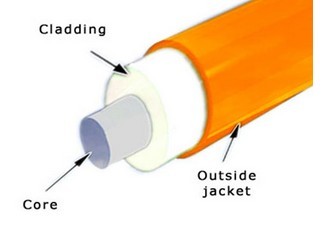
Bare glass fibers are based on silica or other glass materials. The glass surface is susceptible to abrasion and mechanical flaws. To protect the cable from the environment, the buffer coating or jacket fits over the core and cladding. The diameter ranges from 250μm to 900μm, usually 250um for single mode and multimode fibers, but 400um is also very common in polarization maintaining fibers. It provides mechanical protection while allowing for flexibility in the fiber. The buffer coating is usually made of a soft or hard plastic such as acrylic or nylon. Kevlar is a popular choice for the jacket material. It is strong and used to bundle and protect the loose tubes or fibers in the cable. Kevlar protects the fibers when the tension is placed on the cable. The color of this jacket typically depends on the type of fiber, single mode fibers typically wear a yellow jacket and multi-mode fibers wear an orange jacket.
A secondary buffer coating is then applied to the fibers to give protection against external mechanical and environmental factors. This layer may take different designs and its main function is to prevent micro-bending losses.
A. 900um tight buffer. A 900um diameter hard plastic material is coated as the secondary buffer layer. The material is usually Nylon, Hytrel or Tefzel and it provides stiffening for the fiber against outside microbending influences. With tight buffered single mode or multimode optical fiber secondary coating structure is named tight buffered cable. It is the basic components for the manufacture of a variety of indoor cable, which can also be used alone. The tight buffer fiber can be used directly in pigtail for the connection of various types of optical active or passive components, instruments and terminal equipment connections.
B. Loose tube. Another alternative approach to a direct tight buffer coating is to use a 900um loose tube. The 250um or 400um bare fiber is placed in an oversized loose tube in which the fiber is mechanically isolated from external forces. Then, coupled with strengthening the core which used to increase the fiber optic cable strength and the outer sheath, such as aluminum foil and polyethylene jacket, became a fiber optic cable.
C. Filled loose tube. The loose tube discussed above can be filled with moisture-resistant compound which provides mechanical protection and a water barrier layer around the fiber. This filling material is generally petroleum or silicone-based compounds.
There are many types fiber optics from various fiber optic cable manufacturers and you can have a look at FiberStore, who is professional in cables. |
| 2013 年 9 月 9 日 星期一 |
| Large Core Fiber Technology |
分類: 未分類 |
A large core fiber is common fiber optic cable with a relatively large fiber core. Large core multimode fibers have a core diameter of 100 μm or even 400 μm which is really larger than the typical cables of 50 μm or 62.5 μm. A single-mode large core fiber also has a large effective mode area.
Here, the term large mode area fiber is more common and more appropriate, since the large mode area is a particularly important property: it results in reduced nonlinear effects combined with a high beam quality. You've probably seen this product type in high-end applications such as pools, fountains, or as accent lighting on the outside of buildings, strung on trees, lighted pathways for emergency routes, steps, refrigerated display cases, and a multitude of other applications.
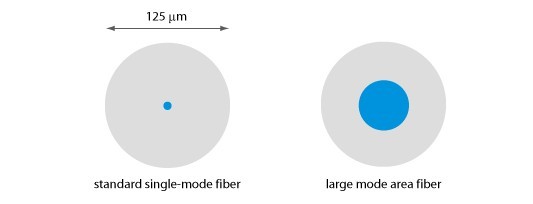
Comparison of bare (uncoated) fibers with a standard large core size (e.g. 8 μm diameter) and a large core (50 μm diameter)
Pros and Cons Of Large Core Fiber
Large core fibers are flexible, but not as flexible as the same diameter made from small diameter fibers. When bent at sharp angles, large diameter fibers are less efficient, as they lose more light than small diameter fiber counterparts.
Large core fibers do a better job coupling light from large focal spot devices with the use of a single large core. There are physical limitations associated with traditional plastic and glass fibers, both must be made in small diameters to maintain flexibility. Therefore, these fibers are gathered in "bunches " to make larger working diameters.
Large core end lit fiber works in same manner as traditional bulk fiber optic cable and offers some advantages over some traditional cables design.
In general, large core fiber advantages over traditional bulk fiber optic cable
1. Can be field applied and installed by almost anyone. (no grinding or polishing is required; but the "cleave" should be uniform and perpendicular to the body of the fiber)
2. More light is transmitted (within equivalent areas).
3. Better color rendering - more light stays in the fiber for longer distances, making the light output look "whiter" or "brighter".
4. Approximate the look of neon without the cost.
5. Higher temperature resistance than PMMA (Plastic acrylic) fiber (100C vs 70C).
6. Available in side emitting type.
7. Reduced transmission of IR energy - less heat is transferred (No filters required).
Disadvantages
More prone to deterioration from UV sources.
Exposure to water/moisture will corrode the core, special jacketing is required for outdoor use.
Prone to chemical metamorphosis within the core, the material becomes less flexible over time.
End face preparation of large core optical fiber is essential to obtain best transmission performance, particularly when high optical power is injected into the fiber. The best transparency is obtained by cleaving the fiber as opposed to polishing where small scratches always remain.
Recommend you to buy fiber optic cable from FiberStore who markets an extensive line of large core fibers. The product is easily adapted to outdoor applications. |
« | 9 | 10 | 11 | 12 | 13 | 14 | 15 | 16 | 17 | 18 | ... | 37 | »
|