所以中間這一段冗長的陳述 跟走山有什麼關係嗎? 我想討論的是資訊 之前我曾經po過一首Marilyn Manson的歌 "Lamb of God" 歌詞寫到 「If you die when there's no one watching and your ratings drop and you're forgotten if they kill you on their TV you're a martyr and a lamb of god nothing's going to change nothing's going to change the world」 我之前就想要討論電視對於這個時代造成的影響 還有台灣新聞頻道的怪現象 說真的 台灣的新聞台 頂多隻能算是所謂的小道消息 而且是一再重複的小道消息 當"新聞"變成一個賣點 一個拿來當作談話性節目討論的"題目" 資訊 思想 就死了 我們隻是很"冷靜""理性""客觀"的在分析這些事情 走山了~~~~~~~來個人或機構負責 走山了~~~~~~~雲層出現怪現象 走山了~~~~~~~死者家屬的特寫悲痛不已 但是我們真的關切這些事情嗎? 當看新聞像是在看綜藝節目的時候 我們會把他們當作娛樂還是教訓?
There are more and more younger cases about dying from “karoshi,” which is death from overwork. What on earth are the problems happening to modern people with abundant materials and advanced technology? Mr. 6, who is a famous blogger, proposes some of his observation and opinion:
Keen Competition:
In the past, employees just need to endeavor to promote after entering a firm. That is a quite clear goal. But now, trend is floating and economic situation becomes more complicated and unstable so that employees need to pay attention to the news opportunities. Sometimes, eye on one city isn’t enough; maybe they need to eye on other continents for new opportunities. In the long run, they might look for several jobs while working in a firm because of fear of getting fired or taking unpaid leave.
He who has health has hope:
We shouldn’t be shortsighted. Life is not a rush race, but a long-termed marathon. We should notice how much potential we possess, and then, based on this load, make a good plan for yourself.
For example, one journalist is, at the same time, an assistant in a college, a MA student taking courses, and a writer on his way. After all, he is like an average modern person—lots of assignment, business, and trifles. However, he insists one single thing: He only works from 9 a.m. to 5 p.m. from Monday to Friday and morning on Sunday. He does NOT work for the rest of the leisure.
Fixed-schedule Productivity:
Regulate yourself that do not turn on the computer after 5 p.m., which is a method he calls “fixed-schedule productivity.” This method is to build a “dike.”
First of all, stay calm to examine your present life and ask when the most suitable working time is. Then, try your best to build a dike to avoid yourself to cross the working line. Because of the dike, he has time to plan for his own “trifles.”
The key lies in a fact that the timetable is the main consideration. During school days, we would carry out the schedule of timetable; however, as adults, timetable is the last choice. All events are tried to be squeezed into timetable.
If we insist to avoid working overtime seriously, we must accomplish several following tasks:
(1) Evaluation and Reject: You have to stand some tasks couldn’t be done so perfectly nor had to be rejected.
(2) Pruning to Get Point: Some inefficient actions should be eliminated so that arranging your timetable might be busier than before. Besides, you must concentrate more while working. Now you must finish your tasks within 12 hours, not 24 hours.
(3) Never waste time one social networks or messagers. You had better finish your job, and then have fun with friends later.
In the beginning, this plan seems difficult to cultivate. After making it a habit, your time would seem to become more and life quality could be better.
Step by Step:
Rome was not built in a day. Take Gary Vaynerchuk, an outstanding wine buff, as an example. His Twitter is really a good hit in the world. He also releases a book named “Crush It!”. This book is not really talking about wine- tasting, but “the good timing to turn your hobby into cash!”
The point is how many years he spent and waited for such a big chance. As a poor kid working in a wine shop and migrated from Russia, he dreamt to be the greatest wine buff in the world. In 2006, he set up a Wine Library TV program with 90000 people watching a day. Then in Twitter, he made it a Q&A. He replies people’s question online within 24 to 48 hours. Therefore, his work is actually to answer customers’ questions. For this dream, he has been waited for 15 years.
“Hit” is a Dream and Luck, not Goal nor Eternity:
Sometimes, being a good hit is certainly a dream, but not a good goal. Everyone’s characteristics is worthy of a good hit and in the internet, there are always new platforms coming out to provide people with new vehicles. Nevertheless, if you are not a hit this time, can you wait for 10 years for a hit? Then after getting the hit, can you continue? Do you determination to upgrade and climb to another climax? Will you preserve your individual value and self?
Your timetable can make your life accomplished and qualified and at the same time, coordinate your dream and reality. Try to organize your own “fixed-schedule productivity” plan for your dream and life. The one who knows how to plan and make good use of it will become the final victor.
at+確切時間(幾點幾分) EX: at seven o’clock(在七點) at noon(在中午) at night(在晚上) at midnight(在午夜) (morning.afternoon.evening隻能用in)
on+星期..星期上下午..特別日子 EX: on Sunday(在星期日) on Sunday afternoon(在星期日下午) on Christmas day(在聖誕節)
in+較長時間(上下午.月.季.年.地名) EX: in morning(在上午) in the summer(在夏季) in the 2007(在2007年) in the Taiwan(在台灣) (noon.night隻能用at)
=================================
以下內容轉載於 Teacher Melinda
【地點】
介係詞 “at”, ” in” 和 ” on” 其地點相關用法
at, in, on 三個都是”在…”的意思 差別隻在於空間的概念
on是用在隻有一面會接觸到而比較開放性的空間 例如:stand on the ground 站在地上
in則是比較狹小的空間 例如:in the classroom 在教室
at是比較廣泛的概念 不像in或on那麼明顯
用in和at比較 at是比較廣泛空間地點的意思 in是比較特殊具體地點的意思 例如: I am in the stadium at National Taiwan University 我現在在台大體育館
那我們現在來看一下這三個介係詞的用法囉!
1. at 用於較明確或範圍較小的地方. 可與門牌號碼結合, 例如: at 40 Washington Street. 也可表示朝著某個方向或目標, 常與動詞搭配使用, 例如: He throw the ball at me. 其他規則如下:
at + position, place. 例如: Wendy is at school now.
at + somewhere around us. 例如: I am at the donut shop.
at + someone. 例如: He is looking at me.
2. in 表示”在…內”, 通常指在某場所的內部. 也多用於較大的地方, 例如: 都市或國家等. 其他規則如下:
in + country/city/town/village. 例如: I live in Taipei.
in + place inside a building.例如: I live in an apartment.
3. on 表示”在…上”, 指與含有點或面的部分接觸. 也常用於表示在街道上. 其他規則如下:
on + surface, floor. 例如: I live on the 2nd floor.
on + street name. 例如: The department store in on Shang-Min Rd.
之前 曾有人問我 在一個建築物裡 也是一個空間 那到底我住在二樓是要用 in 還是 on 我在這裡也順便講一下 如果是與樓層結合 是用”on” 例如: on the 4th floor. 所以說 我住在一棟大廈的二樓 也可以這麼表示 I live in an apartment on the 4th floor.












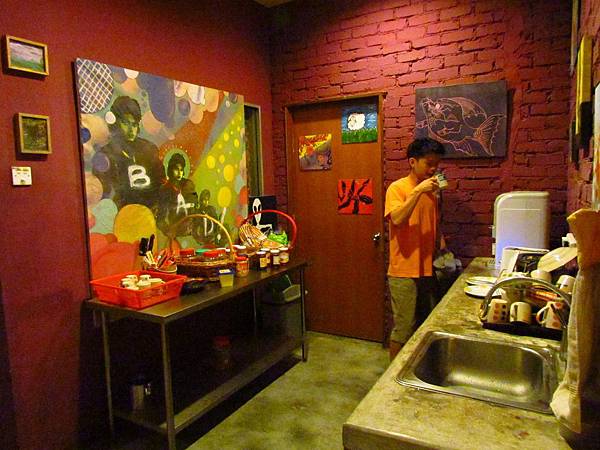
 麵包, 花生醬包


 )








 ,這就是點了這盤炒鴨血的由來,對面客人點了這盤看起來好下飯啊XD


